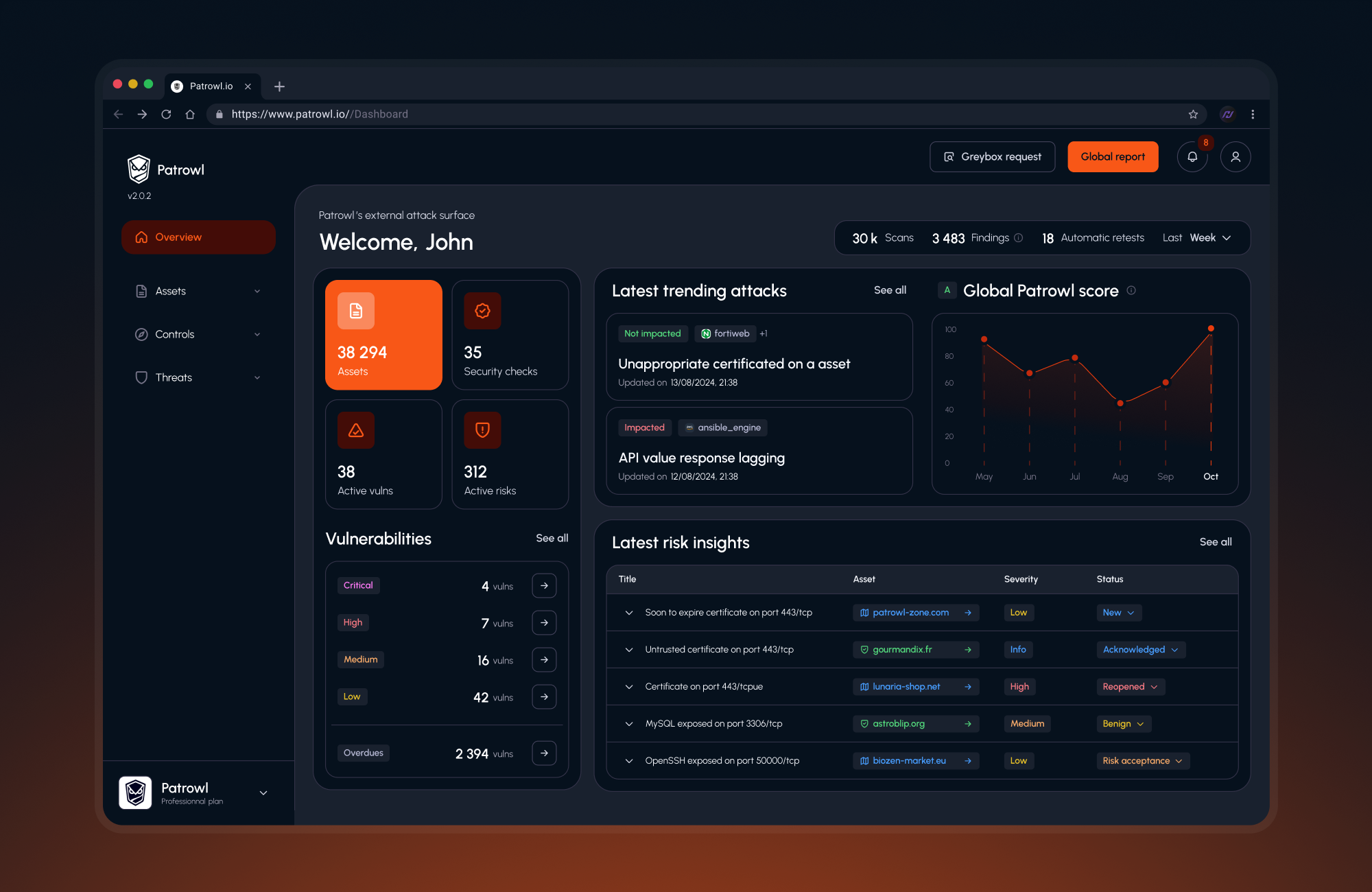
Patrowl.io
Speciality: Continuous External Penetration Testing
Patrowl.io is a France-based SaaS provider specializing in external security posture management; founded in 2020 and headquartered in Paris. The platform offers penetration testing services, including real exploit simulations, attack testing, and remediation, demonstrating its active security testing capabilities.
DORA (Digital Operational Resilience Act)
DORA is a regulatory framework created by the European Union that entered into force in January 2023, with full application required by January 2025. Developed by the European Commission, the European Parliament, and the Council of the European Union, DORA was established to strengthen the digital operational resilience of financial entities across the EU. The regulation emerged from growing concerns about cyber threats, ICT disruptions, and third-party dependencies that could destabilize the financial sector, particularly following increased digitalization and cloud adoption in financial services.
DORA is highly valued in the penetration testing and cybersecurity industry because it mandates comprehensive testing requirements for financial institutions, including advanced threat-led penetration testing (TLPT) for critical entities. Penetration testing companies reference DORA compliance as it creates significant demand for their services—financial organizations must conduct regular security testing, vulnerability assessments, and sophisticated red team exercises to meet regulatory obligations. For cybersecurity firms, demonstrating knowledge of DORA requirements and offering DORA-aligned testing services has become a competitive differentiator, as it shows they understand the specific regulatory landscape their financial sector clients must navigate and can deliver testing programs that meet these stringent EU standards.
ISO 27001: Information Security Management Certification
Origin
ISO 27001 was developed by the International Organization for Standardization (ISO) and the International Electrotechnical Commission (IEC), and was first published in 2005. It evolved from the British Standard BS 7799-2, which was created in the late 1990s. The standard was developed in response to the growing need for organizations to systematically manage and protect sensitive information in an increasingly digital business environment. ISO 27001 has since been revised, with major updates released in 2013 and 2022 to address evolving cybersecurity threats and best practices.
Industry Value and Importance
ISO 27001 is globally recognized as the leading standard for information security management systems (ISMS) and is valued for providing a systematic, risk-based approach to protecting sensitive data. Organizations that achieve ISO 27001 certification demonstrate to clients, partners, and regulators that they have implemented comprehensive security controls and are committed to maintaining confidentiality, integrity, and availability of information. The certification is particularly important for organizations handling sensitive data, as it helps meet regulatory compliance requirements, reduces security incidents, builds customer trust, and often provides a competitive advantage in procurement processes where information security assurance is required.
GWAPT Cybersecurity Certification
Origin
The GIAC Web Application Penetration Tester (GWAPT) certification was created by the Global Information Assurance Certification (GIAC), an organization founded in 1999 as part of the SANS Institute. GIAC developed GWAPT to address the growing need for skilled professionals who could identify and exploit vulnerabilities in web applications. The certification was designed to validate hands-on technical skills in web application security testing, reflecting the real-world challenges that security professionals face when assessing modern web-based systems.
Industry Value
GWAPT is highly valued in the cybersecurity industry because it demonstrates practical expertise in web application penetration testing, one of the most critical areas of information security. Organizations prize this certification because holders have proven their ability to identify common and advanced vulnerabilities in web applications, which remain a primary attack vector for cybercriminals. The certification's emphasis on hands-on skills rather than just theoretical knowledge makes GWAPT holders particularly attractive to employers seeking security professionals who can immediately contribute to protecting their web-based assets and conducting thorough security assessments.
Origin of the OSCP
The Offensive Security Certified Professional (OSCP) certification was created by Offensive Security, a company founded by Mati Aharoni and other security professionals in 2007. The certification was developed to address the gap between theoretical knowledge and practical penetration testing skills in the cybersecurity industry. Offensive Security designed the OSCP to be a hands-on, performance-based certification that requires candidates to demonstrate actual hacking skills in a controlled lab environment rather than simply answering multiple-choice questions.
Industry Value and Importance
The OSCP is highly valued in the cybersecurity industry because it proves that holders possess real-world penetration testing abilities. Unlike traditional certifications, the OSCP's 24-hour practical exam requires candidates to successfully compromise multiple machines in a simulated network environment and document their findings professionally. This hands-on approach has made it a gold standard for entry to intermediate-level penetration testers, and it's frequently requested or required by employers hiring for offensive security roles. The certification's difficulty and practical nature have earned it significant respect among security professionals and hiring managers.
OSWE Certification Overview
Origin
The Offensive Security Web Expert (OSWE) certification was created by Offensive Security, the cybersecurity training company behind Kali Linux and the renowned OSCP certification. Introduced in 2018, the OSWE was developed to address the growing need for professionals skilled in advanced web application security and source code review. The certification emerged from Offensive Security's commitment to hands-on, practical training that goes beyond surface-level vulnerability scanning to focus on understanding and exploiting complex web application logic flaws.
Industry Value
The OSWE is highly valued in the cybersecurity industry because it demonstrates an individual's ability to perform white-box web application penetration testing and identify security vulnerabilities through source code analysis. Unlike automated scanning tools, OSWE holders can manually review code in languages like JavaScript, Python, PHP, and Java to discover subtle security flaws that typically evade detection. This certification is particularly prized by organizations with mature security programs, penetration testing firms, and companies requiring deep application security expertise, as it validates practical skills through a challenging 48-hour hands-on exam that requires candidates to exploit real vulnerabilities in live applications.
- Alsace
- Colas
- Heetch